What size is the playing area?
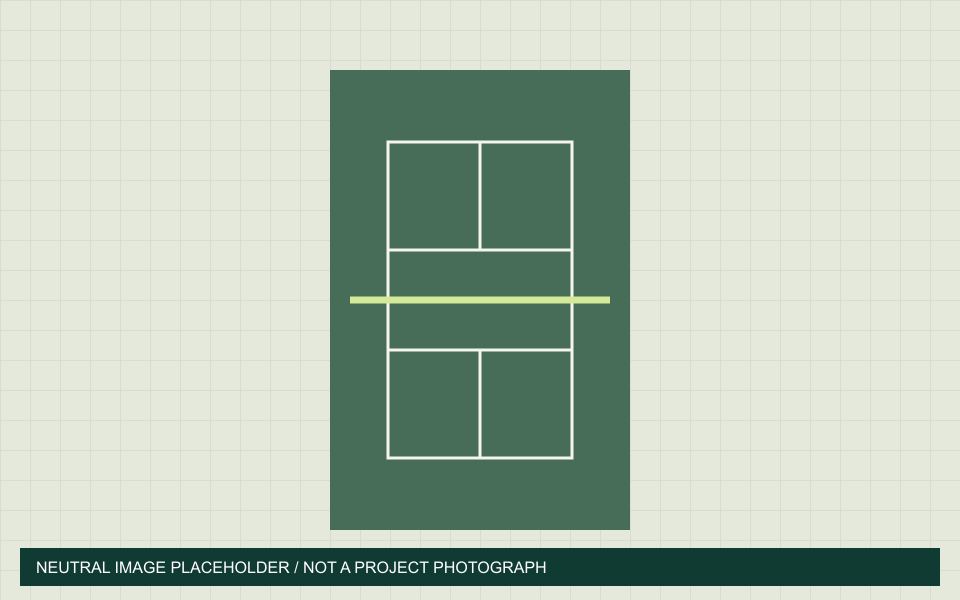
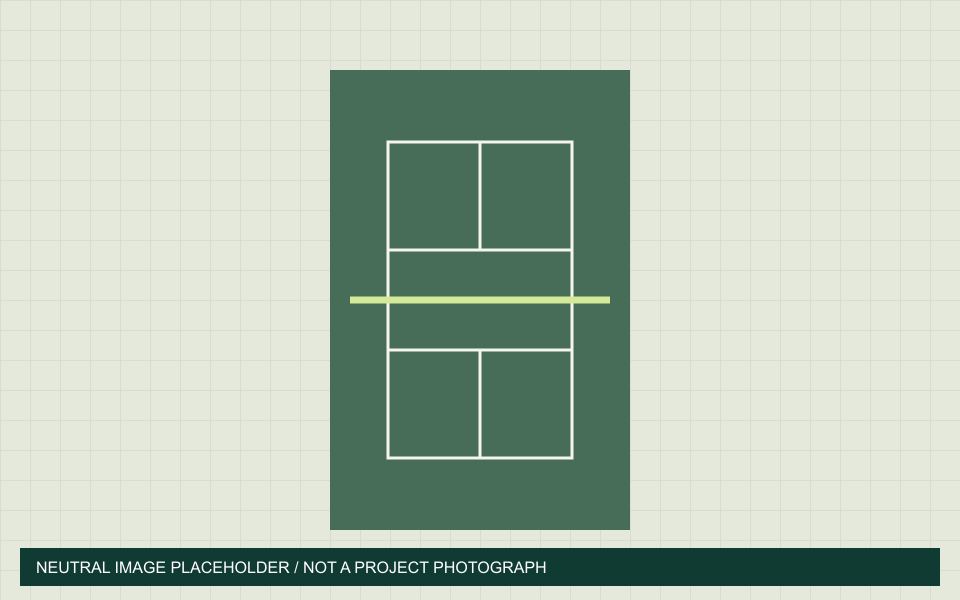
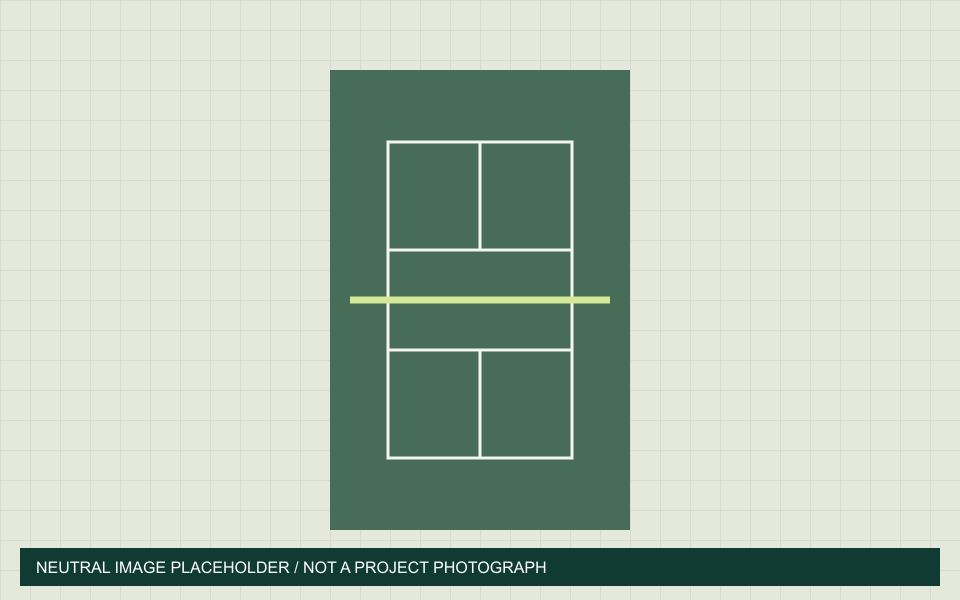
The court is 20 ft wide by 44 ft long for singles and doubles, per USA Pickleball Rule 2.A.1. Lines are 2 in. wide and count as part of the court. Each non-volley line is 7 ft from the net. The net posts are 22 ft apart, measured inside to inside.
Those lines take up 880 sq ft. Everything around them is runoff, the space players use to chase lobs and wide shots.
Is 30x60 or 34x64 the right pad?
USA Pickleball's outdoor construction guidance calls 30×60 "the minimum size that is recommended" and says 34×64 "is preferred."
| Pad | Area | Room beside each sideline | Room behind each baseline | Perimeter fence |
|---|---|---|---|---|
| 20×44 (lines only) | 880 sq ft | 0 | 0 | No runoff; not buildable as-is |
| 30×60 (minimum) | 1,800 sq ft | 5 ft | 8 ft | 180 LF |
| 34×64 (preferred) | 2,176 sq ft | 7 ft | 10 ft | 196 LF |
We build 34×64 when the lot allows and 30×60 when it doesn't. The extra 2 ft of side room and 2 ft behind each baseline is where players stop colliding with the fence.
What does upsizing to 34x64 cost?
Here's the arithmetic, using HomeGuide's January 2026 figures:
- Added area: 2,176 − 1,800 = 376 sq ft.
- Concrete slab only, at HomeGuide's $5–$10 per sq ft: 376 × $5–$10 = $1,880–$3,760.
- All-in court cost, at HomeGuide's $11–$28 per sq ft: 376 × $11–$28 = $4,136–$10,528.
- Extra fence: 196 − 180 = 16 LF. At HomeGuide's chain-link rate of $10–$40 per LF, that's $160–$640, already inside the all-in figure.
So the upsizing delta runs about $4,100–$10,500 at national published rates as of 2026. That lines up with The Kitchen Pickleball's published $5,000–$10,000 for the same upsize. A Tulsa quote can land elsewhere in that band depending on soil, slope and fence height. The construction cost guide has the full line-item picture.
How big is a pad for 2 or 4 courts?
Courts sit side by side along the same north–south axis. When they share one slab, the runoff strip between neighbors serves both courts. Here we keep each court's full side room, so the strip between courts is twice the outer side zone.
| Courts | Basis | Separate pads (area / fence) | One shared slab (size) | Shared slab (area / fence) |
|---|---|---|---|---|
| 1 | 34×64 | 2,176 sq ft / 196 LF | 34×64 | 2,176 sq ft / 196 LF |
| 2 | 34×64 | 4,352 sq ft / 392 LF | 68×64 | 4,352 sq ft / 264 LF |
| 4 | 34×64 | 8,704 sq ft / 784 LF | 136×64 | 8,704 sq ft / 400 LF |
| 1 | 30×60 | 1,800 sq ft / 180 LF | 30×60 | 1,800 sq ft / 180 LF |
| 2 | 30×60 | 3,600 sq ft / 360 LF | 60×60 | 3,600 sq ft / 240 LF |
| 4 | 30×60 | 7,200 sq ft / 720 LF | 120×60 | 7,200 sq ft / 360 LF |
Our arithmetic. The slab area doesn't shrink when courts share runoff, but the perimeter fence drops by a third to a half. Four 30×60 courts on one slab measure 120×60 ft, the same footprint as the new tennis court HomeGuide prices. That's why a tennis slab converts to four courts. See our tennis-to-pickleball conversion page.
Two cautions on big slabs. First, drainage: at 1 in. per 10 ft, a 136-ft-wide slab falls 13.6 in. side to side, versus 6.4 in. along its 64-ft length. We usually slope multi-court slabs end to end. Second, interior divider fences between courts are a separate line item on the quote.
Will a court fit on a Tulsa lot?
Usually width isn't the problem; depth behind the house is. Table 5-3 of the Tulsa Zoning Code sets minimum lot widths and setbacks for detached houses. Table 90-1 keeps tennis courts out of side setbacks but allows them in the rear setback. We plan conservatively, as a tennis court.
| District | Min. lot width | Side setbacks | Width left at min. lot | 30-ft pad | 34-ft pad | 2 courts, 60–68 ft | Rear setback |
|---|---|---|---|---|---|---|---|
| RE | 150 ft | 15 ft each | 120 ft | Fits | Fits | Fits | 25 ft |
| RS-1 | 100 ft | 5 ft each | 90 ft | Fits | Fits | Fits | 25 ft |
| RS-2 | 75 ft | 5 ft each | 65 ft | Fits | Fits | 60 only | 25 ft |
| RS-3 | 60 ft | 5 ft each | 50 ft | Fits | Fits | No | 20 ft |
| RS-4 | 50 ft | 5 ft each | 40 ft | Fits | Fits | No | 20 ft |
| RS-5 | 30 ft | 5 ft each | 20 ft | No | No | No | 20 ft |
This assumes the court's long axis runs front to back. You still need 60 or 64 ft of clear yard behind the house. Patios, pools, trees and sheds all eat into it. Because courts may sit in the rear setback, that 20–25 ft counts toward your depth.
The catch is the fence. USA Pickleball recommends a backstop of at least 10 ft. Tulsa's §45.070-A caps fences inside required setbacks at 8 ft. A court that reaches into the rear setback gets an 8-ft fence on that end unless the Board of Adjustment approves a special exception. The orientation and site planning guide and the permit guide cover both sides of that choice.
This table covers the City of Tulsa only. Suburbs write their own codes.
Can you build smaller than 30x60?
You can stripe 20×44 lines on any flat slab large enough. Play gets cramped once anyone retreats for a lob, and the fence sits right behind the baseline. We'd rather build a 30×60 pad that fits than a 34×64 that crowds your patio.
Whatever size you pick, the slab needs to drain at about 1 in. per 10 ft in one plane, per California Sports Surfaces.
Frequently asked questions
How big is a pickleball court pad?
At least 30×60 ft (1,800 sq ft). USA Pickleball prefers 34×64 ft (2,176 sq ft) for new construction.
How much more does a 34x64 pad cost than 30x60?
About $4,100–$10,500 at HomeGuide's 2026 national all-in rates, for 376 extra sq ft. The concrete alone adds about $1,880–$3,760.
How much space do two courts need?
One shared slab of 68×64 ft at the preferred size, or 60×60 ft at the minimum. Sharing a slab cuts the perimeter fence from 392 LF to 264 LF.
How many courts fit on a tennis court slab?
Four 30×60 courts fit a 120×60 footprint, the size of a standard tennis court.
What's the smallest Tulsa lot that fits a court?
By width, an RS-4 lot at its 50-ft minimum leaves 40 ft between side setbacks, enough for a 34-ft pad. Depth behind the house usually decides it.
Ready to build?
- Backyard court construction: a 30×60 or 34×64 pad sized to your yard on the site plan.
- HOA court builder: two- and four-court shared slabs with board-ready layouts.
- Tennis-to-pickleball conversion: four courts on an existing 120×60 slab.
- Court fencing installation: perimeter and divider fence priced by the linear foot.
Get a quote
Send your lot size and a photo of the yard. We'll check fit at the site visit and send a written scope showing pad size, layout and fence lines. Get a Quote
Construction illustration placeholders